From Compliance to Control: The Path to Software‑Defined Architecture
The Cyber Resilience Act (CRA) is reshaping industrial automation. It’s not optional — it’s the trigger that forces every machine builder to modernize. CRA compliance demands transparency, patchability, and standards‑based software running on an Industrial PC. That’s where the journey begins.
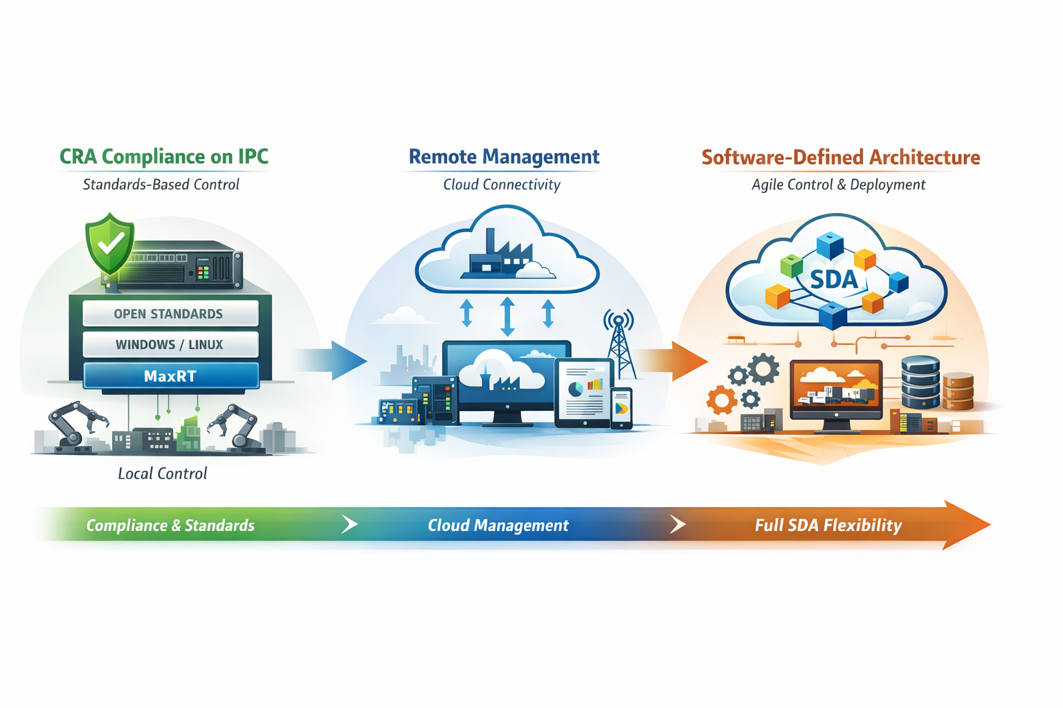
Stage 1 — CRA Compliance on IPC
Machine builders start by moving control workloads onto open, standards‑based IPC platforms. This step delivers visibility, security, and lifecycle control — the foundation CRA requires. MaxRT makes this possible today, providing deterministic real‑time performance on Windows or Linux while aligning with open standards like EtherCAT, OPC UA, and TSN.
Stage 2 — Remote Management
Once control is running on an IPC, the next evolution is remote management. Builders begin connecting machines to the cloud for monitoring, updates, and diagnostics. It’s a natural progression — but it quickly exposes how manual and fragmented legacy architectures still are.
Stage 3 — Software‑Defined Architecture (SDA)
The ultimate destination is SDA — a unified, software‑defined control environment where applications can be deployed, updated, and managed with cloud‑like agility. SDA delivers breakthrough control, cybersecurity, and lifecycle efficiency. It’s how machine builders will manage fleets of machines, not just individual controllers.
Most builders will automate what they have, then realize it’s still too manual. They’ll add remote tools, then see the limits of patchwork integration. The answer isn’t more tools — it’s a new architecture.
SDA is the goal. MaxRT is the on‑ramp. CRA is the catalyst. The evolution has already begun.
Product links: