MaxRT Basic Networking
Overview
IntervalZero’s MaxRT Basic Networking provides networking capability through a base component called the Network Link Layer (NL2) and a set of optional protocol components stacked above the NL2. These components run within the RTSS environment. The NL2 offers raw access to the Ethernet hardware, while the protocol components offer high-level functionality such as TCP/IP and EtherCAT. Applications can use the services of one or more of these network components simultaneously.
This package includes:
- Network Link Layer (NL2)
- Virtual Networking
- TCP/IP
- Network Relay
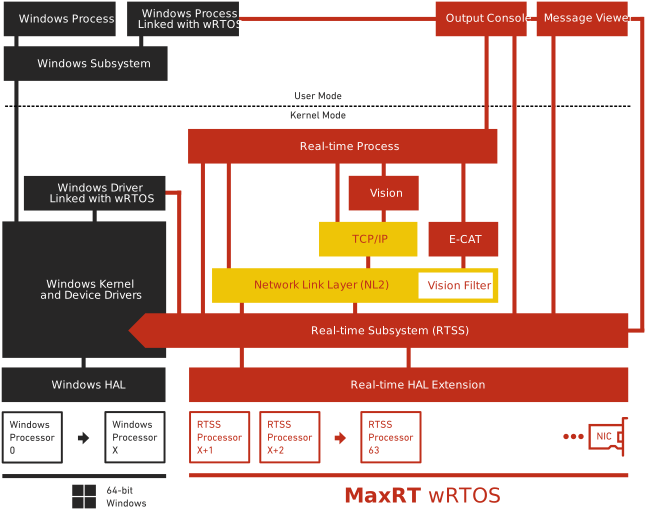
Network Link Layer (NL2) architecture
The Network Link Layer (NL2) software component provides real-time applications with abstract APIs to access network services at Layer 2 of the OSI model, independent of the underlying hardware.
-
- Supports direct use of physical queues or new logical queues to allow multiple application to access the same physical queue
- Hardware timestamping of incoming/outgoing frames
- Cross-timestamping of NIC hardware clock vs CPU clock (both in software and in hardware with PTM)
- Adjusting of the NIC hardware clock
- Assignment of Transmit/Receive Queue interrupts to different cores
- VLAN support
- Ingress filtering based on PCP (Priority Code Point)
- Launch Time
- Credit-Based Shaper (“Qav”)
The image below shows a high-level layout of the NL2 architecture.
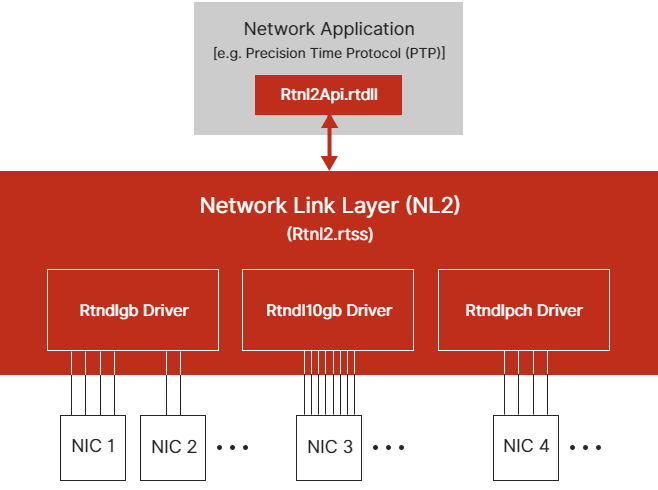
Interactions with Real-Time Applications
The diagram below focuses on the interactions between the NL2 and real-time applications

Virtual Networking
The Virtual Network add-on simplifies the integration of the wRTOS real-time processes with an HMI or a Windows process by delivering a point-to-point connection between Windows and wRTOS that emulates a TCP-based local area network connection on a system. This integration simplifies the user experience while providing more versatile options for how an application can be configured.
TCP/IP
The TCP/IP stack allows real-time processes to use standard socket API calls that conforms to a subset of the functions defined in the Windows Sockets 2.0 (Winsock) specification for Windows, for communication.
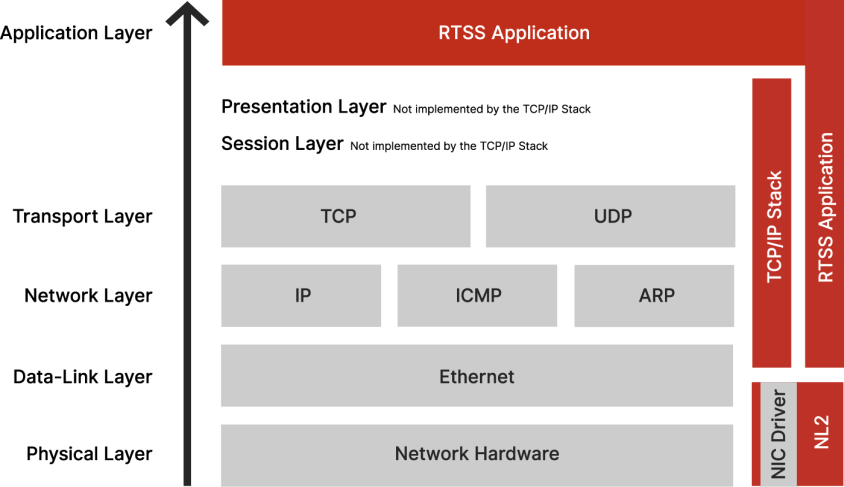
Network Relay
The Network Relay software component establishes a communication channel between Windows and RTSS, enabling Windows applications to send and receive Ethernet frames via NICs owned by wRTOS.