MaxRT wRTOS™
Overview
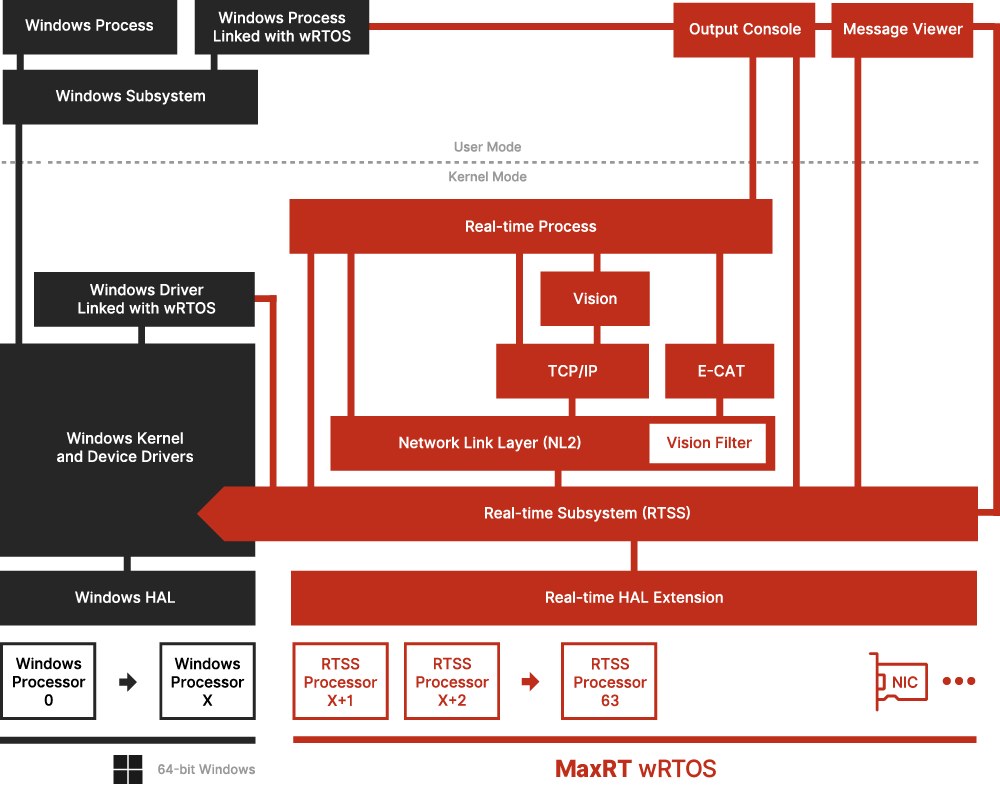
MaxRT wRTOS™ provides determinism or hard real-time on multi-core processors while co-resident with the Windows operating system. MaxRT wRTOS® enhances Windows by providing hard real-time and control capabilities to a general purpose operating system that is familiar to both developers and end users.
wRTOS consists of a separate real-time Subsystem (RTSS) that schedules and controls all RTSS applications independently of Windows. The combined solutions deliver a world-class user experience and outperform real-time hardware such as DSPs, FPGAs, and MCUs and reduce the development costs for systems that require determinism or hard real-time. Symmetric multiprocessing-enabled wRTOS takes full advantage of 64-bit memory and performance capabilities. Uniquely, the wRTOS RTOS scheduler enables embedded real-time applications to directly access the 512GB of addressable physical memory available on 64-bit Windows. This is critical to modern-day real-time systems and represents a gigantic leap from the 4GB physical memory limit of traditional 32-bit Windows systems. The 4GB barrier has stymied innovation in many industries that depend on real-time systems and that require memory access far beyond 4GB.
Determinism
Guaranteed Precision – set timer periods down to 1 microsecond, and Interrupt Service Thread (IST) latencies of less than 10 microseconds
Separation from Windows – Windows processes cannot interfere with real-time applications
Scalability – one scheduler is used across all real-time processors. Symmetric multiprocessing (SMP) aware scheduler utilizes both priority-driven and pre-emptive algorithms to ensure critical thread context switches; and yields to threads of high priority occur in the sub-microsecond range
Standards
- Like RTX64, its predecessor, MaxRT wRTOS™ has been designed for supporting standards. Running on Windows 11, it supports Visual Studio for development environment and C/C++ for main programing language. All Windows drivers, tools and protocols are available. It support EtherCAT and the most advanced networking technologies such as TSN. Moreover, MaxRT wRTOS™ is committed to be compliant with the Cybersecurity Resilience Act. Supporting standards is a key for protecting our customers investment in our software.
Networking and protocols
- wRTOS provides networking capability through a base component called the Network Link Layer (NL2) and a set of optional protocol components stacked above the NL2. These components run within the RTSS environment. The NL2 offers raw access to the Ethernet hardware, while the protocol components offer high-level functionality such as TCP/IP and EtherCAT. Applications can use the services of one or more of these network components simultaneously.
- It includes:
- Network Link Layer (NL2)
- Virtual Networking
- Network Relay
Network Link Layer (NL2) architecture
-
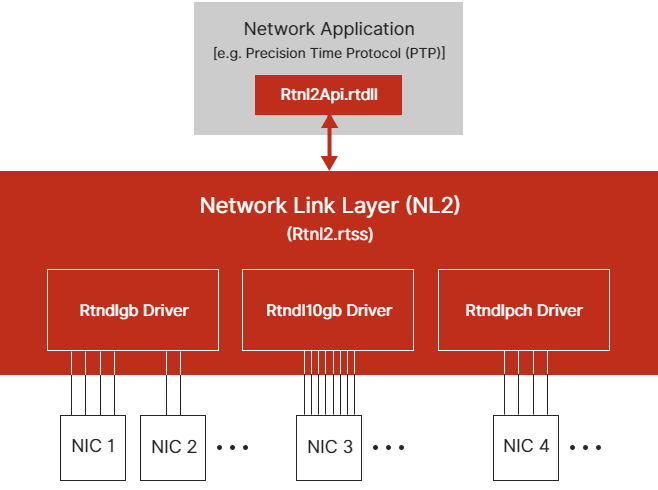
The Network Link Layer (NL2) software component provides real-time applications with abstract APIs to access network services at Layer 2 of the OSI model, independent of the underlying hardware.
- Supports direct use of physical queues or new logical queues to allow multiple application to access the same physical queue
- Hardware timestamping of incoming/outgoing frames
- Cross-timestamping of NIC hardware clock vs CPU clock (both in software and in hardware with PTM)
- Adjusting of the NIC hardware clock
- Assignment of Transmit/Receive Queue interrupts to different cores
- VLAN support
- Ingress filtering based on PCP (Priority Code Point)
- Launch Time
- Credit-Based Shaper (“Qav”)
- The image below shows a high-level layout of the NL2 architecture.
Interactions with Real-Time Applications
- The diagram below focuses on the interactions between the NL2 and real-time applications:

Virtual Networking
- The Virtual Network add-on simplifies the integration of the wRTOS real-time processes with an HMI or a Windows process by delivering a point-to-point connection between Windows and wRTOS that emulates a TCP-based local area network connection on a system. This integration simplifies the user experience while providing more versatile options for how an application can be configured.
Network Relay
- The Network Relay software component establishes a communication channel between Windows and RTSS, enabling Windows applications to send and receive Ethernet frames via NICs owned by wRTOS.
Additional Purchasable Features
• MaxRT Basic Networking
- Including a TCP/IP stack, Network Link Layer (NL2), Network relay and Virtual Network capabilities, it makes networking suitable for demanding industrial automation tasks, especially in a distributed system environment. Learn more about MaxRT Basic Networking
• MaxRT GigE Vision
- Features a GigE driver and support for deterministic image capture and analysis, which is valuable in applications like Automated Optical Inspection (AOI). This allows for real-time quality control and defect detection in manufacturing processes. Learn more about MaxRT GigE Vision
• MaxRT Fieldbus
- Provides an EtherCAT stack and tools for high-speed, deterministic control of EtherCAT devices. Learn more about MaxRT Fieldbus